No Police Merger in Hutt Valley

The report is out, and it is good use for opponents of Project Awakairangi . This issue has caused a great deal of concern amongst the public and staff over the way this project has been handled. HuttNZ has also expressed concern over how this matter has played out and also expressed doubts as to the release of the outcome, I stand corrected and am glad the matter has been made public.

Announcement 

The Lower Hutt and Upper Hutt police areas will not be merged, police bosses have announced.

Wellington district commander Superintendent Gail Gibson said today she had reviewed the report on project Awakairangi – which was looking at amalgamating the neighbouring police areas – and decided to retain Upper Hutt’s area commander role.

Police wanted to provide the ”best possible service” to the public, she said.

”We have decided that part of that service includes Upper Hutt retaining their area commander.”

However, reviews of police resources in the district would continue.

Ms Gibson thanked the Upper and Lower Hutt communities for their submissions on the proposal.

”During the project process, support for police in Upper Hutt and Lower Hutt was clearly apparent.”

Police authorities announced in February that they were looking at options for the two districts. At the time, Superintendent Pieri Munro said he did not want the number of frontline police to change or for police stations to close, but that a reduction in behind-the-scenes staff was possible. One of the area commanders might lose their job, he said.

The region’s civic leaders were upset by the merger proposal, Upper Mayor Wayne Guppy called it the biggest issue his community had faced, while Lower Hutt Mayor David Ogden said he could not understand why police would want to change something that was working effectively.

The two districts have about 240 staff in total.

Hutt Valley Police – Merger update Upper Hutt says NO

Upper Hutts petition against a police merger with Lower Hutt police has gained more than 6000 signatures.

Organisers hope to take it to Parliament later this month but a further push for more signatures is under way this week and more petition forms will be taken around the CBD this week.

People are very angry that police district commander Superintendent Pieri Munro did not attend last weeks meetings (see below), and unfortunately this I believe has lite the fire for more anger over this proposal.

Local MP Chris Hipkins has ben an advocate of the petition by collecting signatures around Upper Hutt

“One of the messages I will be giving the minister that came through very strongly is local people’s expectations that focus on frontline policing. Any review that would take senior police out of the Hutt Valley seems to be going in the wrong direction. The minister has an obligation to make sure this does not happen. That seems to be totally at odds with the government’s stated commitment to frontline policing services”

The petition can be signed at Upper Hutt City Council, Library, McArthurs Real Estate, Chris Hipkins electorate office, Upper Hutt Leader.

Below is the link to the website, and an opportunity to download a petition there as well

—————————————————————————————————————————————–

May 5th

Last week two public meetings were undertaken by the Police in Lower and Upper Hutt.

Police have advertised these meeetings as a chance for locals to put their views to the police on what works with local policing and what doesn’t. Project Awakairangi is a police review of services they provide, the project is about which local services would the public like to see, or retain, the most and which could they do without. 

The police have had terms of reference for this project available. The underlying principles behind the project are below

“A project team has been established with Terms of Reference to explore enhanced safety and police service delivery opportunities in the Upper Hutt and Lower Hutt police area commands.

Superintendent Pieri Munro, Wellington Police District Commander, has asked for a report with findings and recommendations by 30 June 2009.

The project is called Awakairangi – the Maori name of the Hutt River formed by tributaries from the surrounding ranges and their combined flow through Upper Hutt and Lower Hutt, joining with Wellington Harbour at Petone.

Superintendent Munro acknowledged news of the project had raised some concern amongst police staff and the public. He hopes the public discussion paper including Terms of Reference will help provide understanding and reassurance for staff, and the Upper Hutt and Lower Hutt communities.

He reassured people that no police stations or community policing centres will close; that face to face service delivery to the public will not be diminished and that the purpose is to enhance safety of the public and police.

“Seeking the views of police staff and key partner agencies including local councils will be an important part of the project team’s focus,” Superintendent Munro said. “This includes opportunities for face to face meetings and other communication and feedback tools including web based technology.””

I attended the meeting in Upper Hutt which had  roughly about 80 people turn up at the Hapai Club in Fergusson Drive last Thursday (A summary of the Lower Hutt meeting is here).

In general terms most of the Upper Hutt residents feel that this project is about merging of police services under one district with Lower Hutt being the principal station, Upper Hutt being reduced to a satellite station.

There has been strong opposition to this project in Upper Hutt with a petition doing the rounds and an active website www.nopolicecuts.co.nz citing rational reasons for the possible outcome of this project not to proceed. Even the local Upper Hutt Mayor was upset over the scheduling on this meeting, as it clashed with a well advertised Community Planning meeting.

Having attended the meeting I walked away with no clearer picture of what the Police are intending to do with this Project, equally that was probably not their goal. Most certainly I can attest that they should have got the message that people within Upper Hutt are not happy with any reduced police staff numbers in their community.

While I understand the need for mangement reviews, they are usually ongoing and generally do not require public input to reach a conclusion. I have no doubt that be guaging public opinion from these meetings, a requirement has been satisfied (community involvement) and as such will be used as a precussor to a major operational change in policing in the Hutt Valley.

I will wait the outcome of the report from Mr Munro, I hope the findings will be made public, not lost in obsecurity but again I have my doubts as other Police reports have shown .

If anything the Police representatives should have come away with is that the community expects transperancy from the Police as to its goals and operational dealings especially as they directly relate to the community it serves.

Just front up and tell concerned citizens why the project was implemented in the first plce and what are the goals?

Police to travel on Trains in the Hutt

If you see police on a Tranz Metro train out of Wellington, don’t be alarmed – it’s a new initiative between Tranz Metro and community policing.

The project, launched from Wellington Railway Station today, literally takes police in a new direction.

Having Community Constables using the trains provides people with an extra opportunity to discuss local concerns with Police. “It’s along the lines of policing where the people are”, says Inspector Michael Hill, Acting Area Commander for Wellington. “The rail network is widely used so we are getting the ability to work on and from trains”.

In the near future, Community Constables may be seen talking with passengers on the Upper Hutt, Melling and other rail lines. With many commuters choosing the convenient, environmentally friendly trains, it is hoped they will use the time to discuss local concerns.

“We work closely with the authorities and we are delighted that Police are using the Tranz Metro train service like so many Wellingtonians,” comments Mark Pettitt, Security Manager of Passenger Rail at KiwiRail.

via NZ Police

Hutt Region City Councils Long Term Council Community Plan (LTCCP)

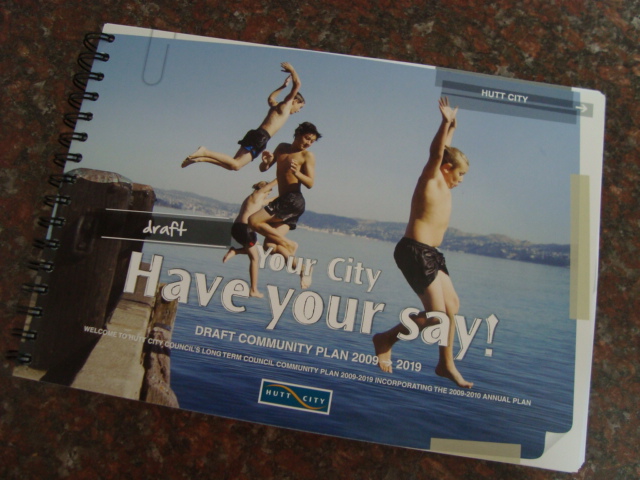
Hutt City Draft Community LTCCP 2009-2019

Hutt City Draft Community LTCCP 2009-2019

Your submission is required by the 5pm Thursday 30th April.

There are several other draft plans that effect the Hutt Valley at present. Listed below are the times for submissions:

Upper Hutt City Councils Draft Plan 1 April – 13 May 2009

Greater Wgtn Regional Council Draft Plan 23 March-24 April at the same time they will also be undertaking separate consultation between 23 March and 24 April on the Regional Land Transport Programme for the Wgtn Region.

But lets look at the Hutt plan in a bit of detail. First its 325 pages long, thats right 325 pages. What are they talking about that takes that much material. Well each household would have received a summary via post.  This document is 14 pages long, and provides a blurb from the Mayor and CEO as to the purpose behind the LTCCP, which is to look ahead 10 years, an opportunity to provide your views on projects and activities they are proposing and how they will spend the money to fund this in the coming 10 years. The 325 page document gives far greater depth, in fact its frightening that it takes this much space to explain their goals / activities etc. One puts this up against the Greater Wgtn plan of the same agenda (Long term planning) it only runs to 223 pages, 100 pages less.

But the whole purpose of these documents is to provide greater accountability to you the ratepayer, you pay these guys to provide services. The document is loaded with facts and projections.

A cursory look unfolds a couple of  facts /harbingers

  • Rates  Expect these to be around 2-3% increase each year (includes inflation). If inflation is higher rates will be higher.               
  • Income Council gets approx 64% of its income from rates, property owners in the Hutt 
  • Debt The Council is $75m in debt (2009) and expects to get this down to $30m (2015)

Several projects (in excess of $1/2million) are listed for consideration on the submission form, and as democracy goes the only way you can have your say is via a submission, part of the  form survey. This leads to a chance to present your submission to the Mayor in early May, if you desire. The process is similar for the other LTCCP plans.

One has to dig quite depth to find specifics, but in line with current postings of interest in the Hutt Valley, the  railway line is one subject that crosses the boundaries of several of these plans. By searching through the plans available one can find some interesting points:

1.   Hutt LTCCP P.165 investigate with Greater Wgtn Regional Council opportunities to expand parking at Waterloo Railway station (Park & Ride).

2. Greater Wgtn LTCCP P.20 Introduce a charge for Park & Ride Parking. Investigate a levy for parking at Park & Ride areas that are currently experiencing high usage where demand exceeds supply. see  http://viewer.zmags.com/publication/1b30b368#/1b30b368/21

One could concur that the Waterloo interchange Park and Ride parking is to be one of these areas. It currently is the second highest use railway station (behind Porirua). It has 617 carparks, and on most days carparks are scarce. An interesting fact also is that 50% of people that use the park live within 1.85km of the parks.

I would think that in light of this, albeit from 2 seperate plans that consideration be given to the commuters who use rail, that this matter be brought to light sooner rather than later.

How come the current parking has been provided for many years without charge?

Is charging going to impact on other transport alternatives, is it  not part of Greater Wgtn Regional to ensure traffic corridors are sustained and maximised?

Would it not be courtesy to state within the Hutt Plan that charges are contemplated for this exercise?

Unfortunately the above can only be answered by the Councils involved in time, what I am more concerned about is a level of transparency in each councils agendas especially where councils have dual responsibility.

What else lies within these documents ?  

The only way is to look at these documents in greater depth especially around areas that concern you, or impact on your residence or livelihood. Find any let me know!


Hutt Valley Crime and Safety Survey 2009

Interviews are currently underway and are due for completion in June this year. 5400 people throughout New Zealand are being surveyed about how safe people feel within their community, if they have been a victim of an crime in the past year, and if so what the effects were. Several other in depth questions are also asked. The survey is private and cannot be traced.

It is not related to the current review of policing in the Hutt Valley (Project Awakairangi) which is been undertaken.

Full details here: http://www.justice.govt.nz/media/article-nz-crime-safety-survey.html